
How a component audit became a governance problem in a decentralized organization and why defining a system is not enough without ownership
Introduction
There is a class of problem that is not a quality issue. It is an authority problem. What happens when a system you depend on is structurally broken, you can see exactly how, and you have no formal mandate to fix it?
This emerged during a product engagement in a regulated MedTech environment. The company maintained a portfolio of multiple products, each owned by an independent team — developers, business analysts, designers, QA — operating in separate systems, with their own terminology, priorities, and release cycles. A shared component library cut across all of them, maintained by a dedicated team and intended to enforce consistency.
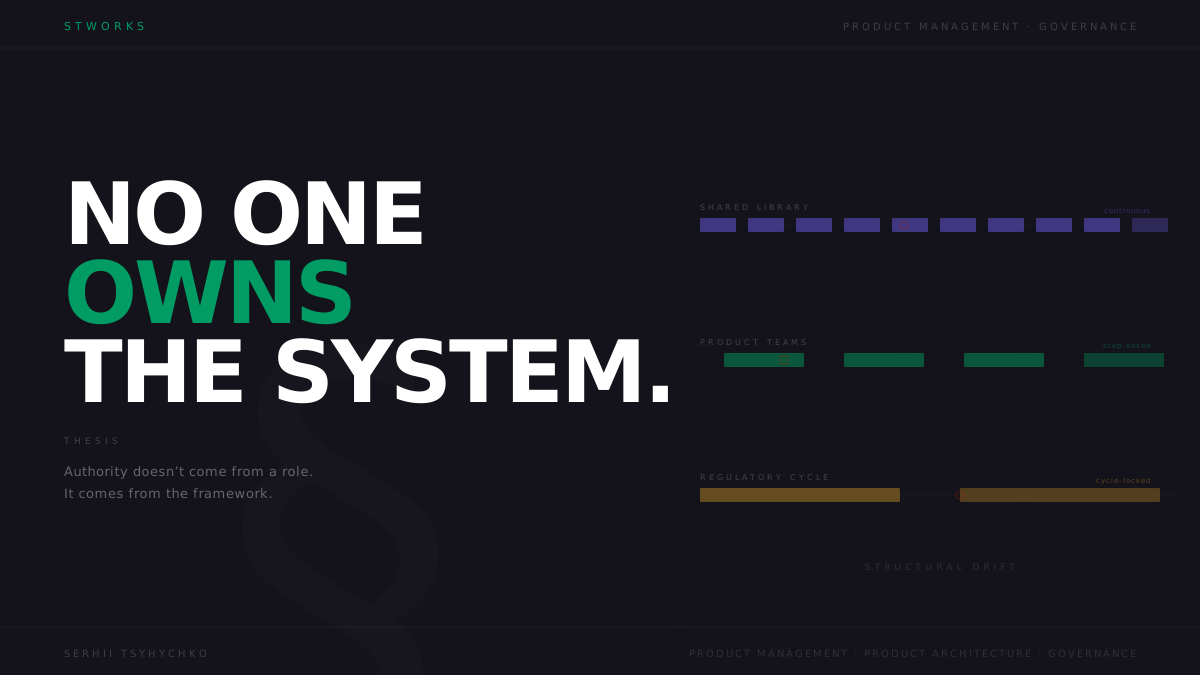
The library shipped updates every two weeks, while product teams consumed it in frozen versions due to regulatory validation constraints. Once a release passed validation, no changes from the shared library could enter the product until the next cycle. From a distance, this setup suggests control. In practice, it creates structural drift.
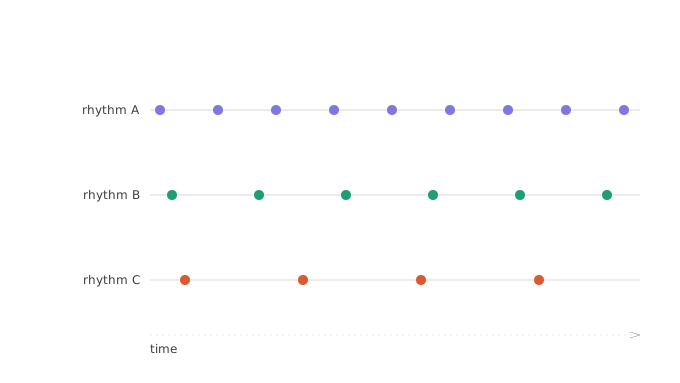
Three independent rhythms operate simultaneously: continuous updates in the shared library, step-based consumption by product teams, and regulatory cycles locking each product to a past snapshot. These rhythms do not align, and the misalignment itself — not any individual component — becomes the source of inconsistency.
The Emergence of Inconsistency
Inconsistencies began to surface while working on requirements within a single product. The same component behaved differently depending on context: token-based sizing in one case, fixed dimensions in another, container-driven behavior in a third. Input fields changed labeling logic without a clear rule, and structural variations appeared in similar table elements without defined constraints.
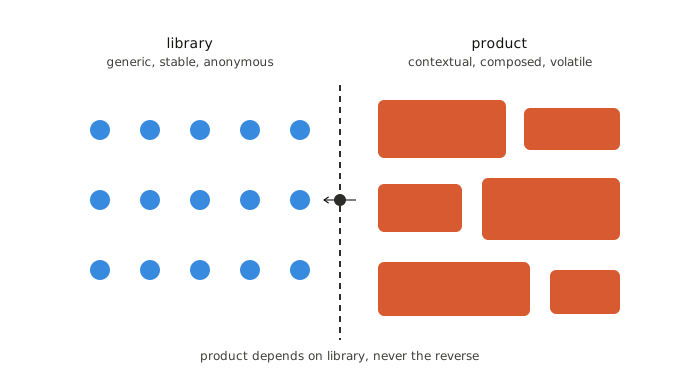
These were not isolated defects but recurring patterns. The root cause was visible in the way the shared library had been constructed. A single generalized component layer attempted to serve multiple products simultaneously, forcing components into overly abstract definitions while pushing edge cases into product-specific customizations. Documentation described intent rather than behavior, and the library evolved independently from the products that depended on it.
I initiated a component audit focused on the elements causing visible issues. The method was deterministic: components were instantiated, inspected in dev mode, token bindings and dimensions recorded, and inconsistencies captured systematically. Each section concluded not with a verdict, but with a question — because the goal was not to assign blame, but to make the problem explicit in a form that could not be ignored.
What the audit produced was a list of inconsistencies. What it revealed was something fundamentally different.
The System Was Undefined
At a certain point, the problem stopped being about components. It was not a documentation issue, and it was not an implementation issue. It was a definition problem. The system was not inconsistent — it was undefined at the level where consistency is determined.
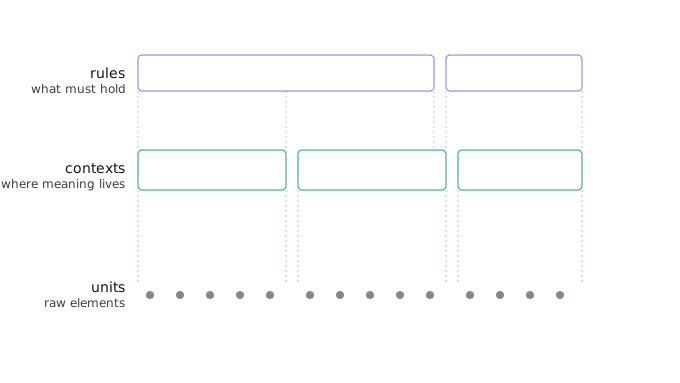
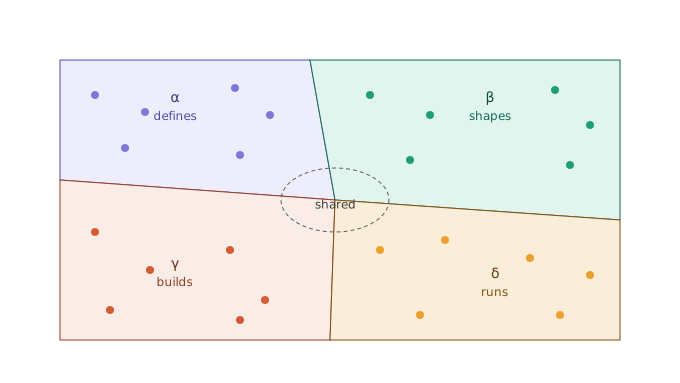
Three fundamentally different layers were being treated as one: atomic interface units (what something is), interaction contexts (where and how it appears), and usage rules (when it is valid and under what conditions). In the shared library, all three were collapsed into a single undifferentiated concept of “components,” which made any consistent behavior structurally impossible.
Every inconsistency observed in the audit was a downstream consequence of this collapse. Fixing individual components would only reproduce the same class of problems, because the ambiguity originated upstream.
The way forward was not to determine which version of a component was correct, but to introduce a layer beneath the disagreement — something neither team owned, but both were required to respect.
Reintroducing a Source of Truth
That layer already existed in the system. The product operated under formal specifications that defined atomic interface units and their constraints. These specifications were created for regulatory traceability rather than design decision-making, which is why they had been bypassed in day-to-day work. Reintroduced into the process, they became the foundation.
Item types were defined by the specification, interaction contexts became a separate layer, and usage rules described valid combinations between them. This separation transformed the discussion from interpretation to alignment. Instead of debating which implementation was correct, the question became whether a given behavior was consistent with a validated source of truth.
In a non-regulated environment, this level of formalization may be unnecessary. In a regulated system, it is leverage. It shifts the conversation from opinion to traceability and reduces the degrees of freedom where inconsistency can emerge.
The Limits of Validation
Defining the system did not resolve the next constraint: what could realistically be validated. The shared library operated under conditions that made exhaustive quality assurance structurally incoherent. Updates were continuous, consumption was version-locked, and different teams worked with different snapshots simultaneously. A reported issue could refer to an outdated version, a deliberate change, or a regression — without a reliable way to distinguish between them.
In such conditions, increasing test coverage does not solve the problem. Without clearly defined boundaries, validation itself has no scope. The system needed to shift from attempting exhaustive coverage to defining responsibility.
At the library level, validation can be deterministic: token consistency, structural completeness, defined states, naming conventions, and alignment with specifications. These are bounded checks that can be executed when a version is frozen. Everything else — product-specific scenarios, behavior in frozen versions, and real usage contexts — belongs to product teams.
The shared library is not a standalone product. It is a governed resource, and treating it otherwise creates expectations the system cannot satisfy.
Adoption Without Authority
The work produced two different outcomes. The structural model — separation of item types, contexts, and usage rules anchored to formal specifications — was adopted by developers and business analysts. It became the foundation for requirements, test cases, and implementation decisions because it provided immediate value and required no permission to use.
The governance model followed a different trajectory. Validation boundaries, ownership definitions, and feedback loops between teams were broadly supported but never formally adopted. The reason was not disagreement, but the absence of ownership. No single role was responsible for making a cross-product decision, and without ownership, agreement did not translate into action.
The system was defined, partially adopted, and remained broken — not because the model was incorrect, but because no authority existed to enforce it.
From System Design to Governance
This clarified a fundamental constraint of shared systems in decentralized organizations. A shared resource cannot be fixed by someone who does not own it. It can only be redefined through rules, and those rules must be grounded in something external, usable without permission, and adoptable without removing autonomy from the teams that depend on them.
The audit was not the work; it made the problem visible. The formalization was not the work; it provided a shared language. The actual work was governance — defining what the system controls, what it does not, and where responsibility resides when no formal ownership exists.
Final Principle
In systems like this, authority does not come from the role. It comes from the framework. The person who defines the rules becomes, in practice, the one the system aligns around even when formal authority is absent.
That shift is not documented. It becomes visible only through what the system becomes next.
This article is based on product architecture work conducted within a regulated enterprise MedTech environment. Specific organizational and product details are confidential.