
§3 Practice Repository
Situations & Solutions
Articles, problem breakdowns, guides, and solution paths from real working contexts
AI Constraints Governance Metrics Product Architecture Product Management Product Strategy Systems Thinking UX
-
 1,060 words4–7 minutes
Discovery Has a Dependency Structure
Discovery depends on knowing what a decision requires: a clearer product model, valid evidence, explicit criteria, or authority to act. As AI accelerates research and execution, the critical skill is identifying which uncertainty to reduce next—and what can safely remain unresolved.
-
 1,188 words5–8 minutes
A System That Cannot Say Unknown Becomes Agreeable
Agent loop maturity models describe capability. They do not say when the work is finished. After four independent validations of the same contract failed to converge, the missing piece was not a better validator — it was a legal state for “unknown.”
-
 937 words4–6 minutes
When Agents Become the Team, Roles Must Be Explicit
LLM agents can generate plans, code, reviews, fixes, and next steps. That does not make them a team. Reliable AI work starts when roles, authority, validation, and acceptance are made explicit before execution.
-
 744 words3–5 minutes
We Learned to Generate Answers Faster Than We Learned to Understand Questions
We tend to think AI changed how quickly we can find answers. The more interesting change may be that it exposed how often we never fully understood the question. As answers become cheaper, unclear goals, missing context, and contradictory assumptions become harder to hide.
-
 2,391 words10–15 minutes
The Architecture Below the Chat
AI work does not stop at the chat interface. Different tasks require different layers: projects, structured notes, RAG interfaces, agentic workflows, orchestration, databases, and custom infrastructure. This article explains the path from simple chat use to deeper AI architecture, based on practical experience with fragmented context, retrieval, decomposition, cost control,…
-
 1,264 words5–8 minutes
The New Layer Above the Specialist
AI has added a new layer above professional work. Specialists now operate not only inside their discipline, but also across AI context, validation, handoffs, and recovery. The tools are fragmented, but the responsibility for keeping context meaningful already belongs to the specialist.
-
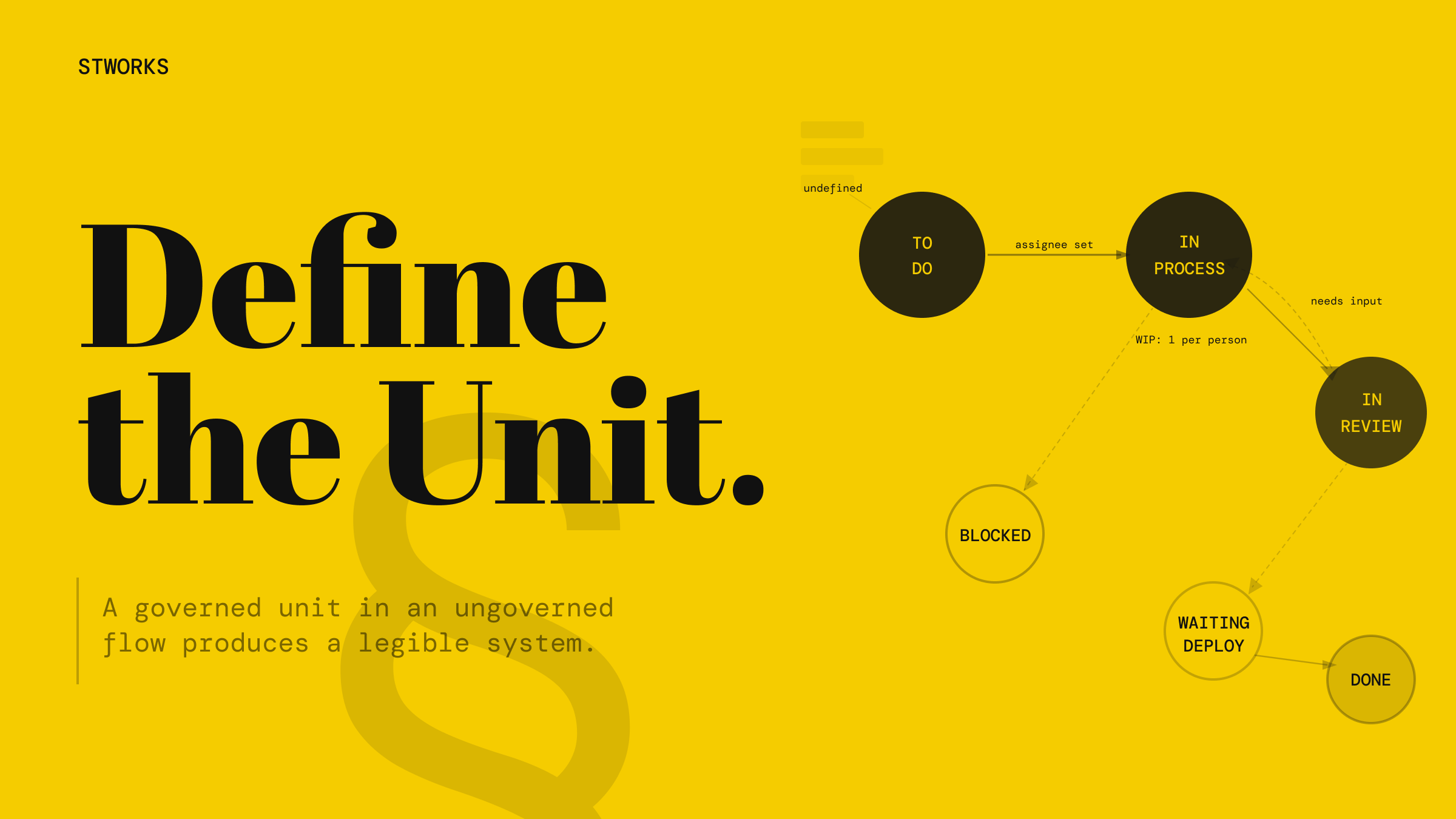 1,677 words7–11 minutes
When the Flow Is Ungovernable, Define the Unit
When work is chaotic and priorities change constantly, adding frameworks often fails because the real issue is not flow but an undefined unit of work. In one small contract-based team, bugs, features, large initiatives, and quick fixes were treated as the same type of task. That made ownership, status, and…
-
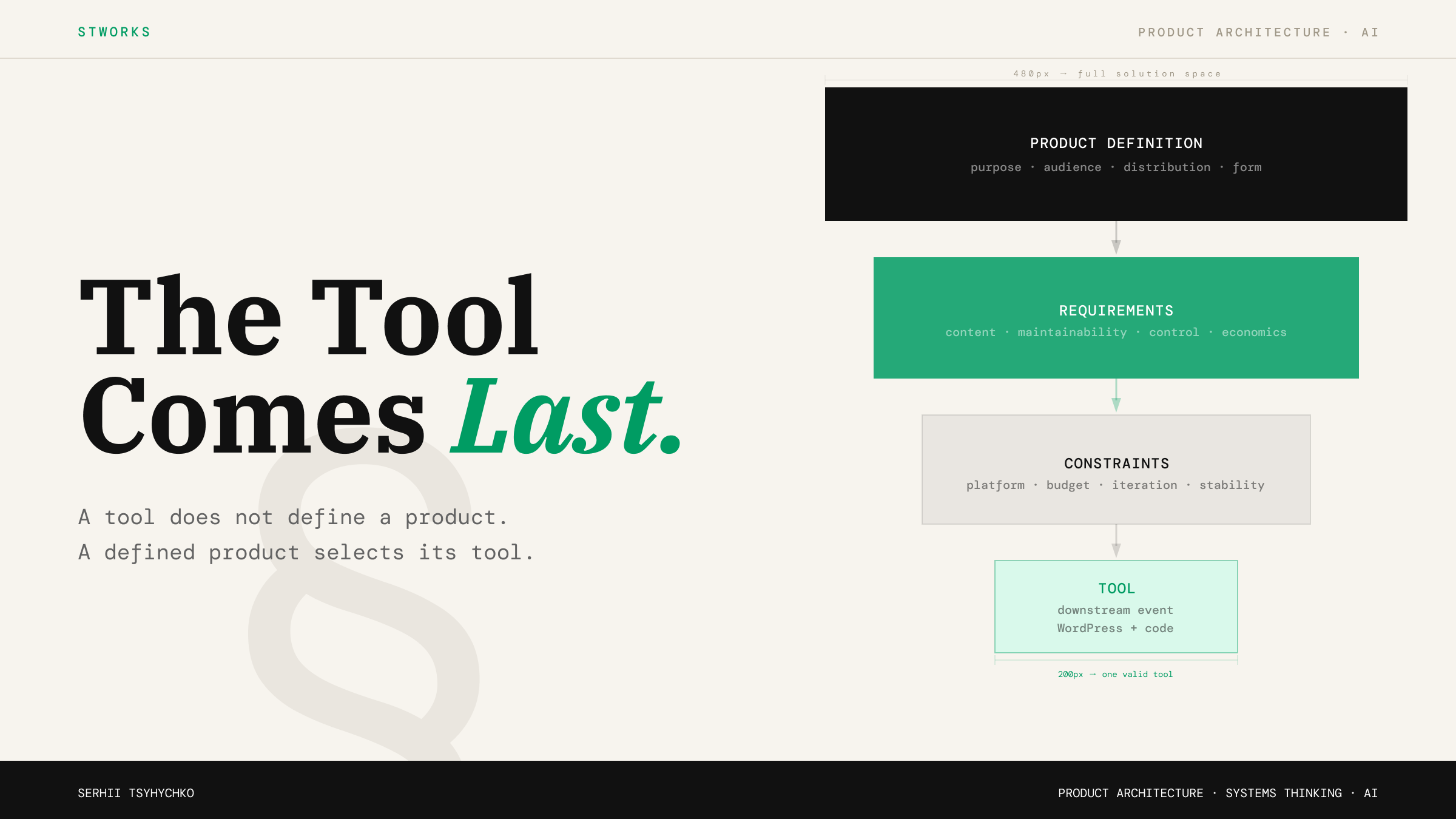 1,873 words8–12 minutes
When the Tool Search Takes Too Long, You Were Not Choosing a Tool
Building a personal website first looked like a tool-selection problem, but the real issue was missing product definition. The need was clear, yet the actual system was not: audience, purpose, structure, content model, maintainability, and control. Exploring no-code tools, AI builders, and platforms helped test options, but none could replace…
-
 959 words4–6 minutes
When Execution Gets Cheap, Definition Becomes the Bottleneck
As execution becomes cheaper through AI and modern tooling, the main constraint shifts from building to defining what should be built. In the past, slow delivery created time to rethink weak assumptions during implementation. That buffer is shrinking. Teams can now generate prototypes, flows, and documents quickly, but speed does…
-
 801 words3–5 minutes
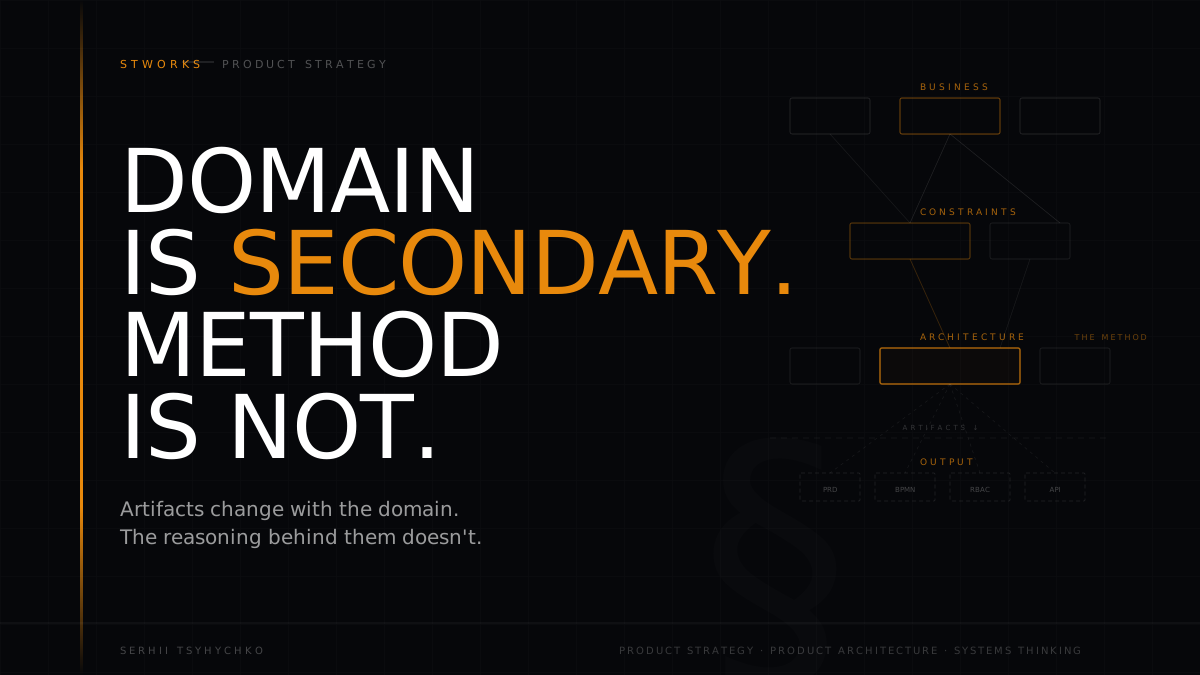
Product Architecture Is a Method, Not a Domain
Product architecture is often mistaken for a software discipline because it is usually presented through PRDs, APIs, flows, and engineering artifacts. In reality, those are outputs, not the method itself. The core skill is defining systems before execution: clarifying constraints, roles, transitions, rules, and decision logic so outcomes become predictable.…
-
 1,072 words5–7 minutes
Beyond Numbers: Making Metrics Make Sense
Metrics often fail not because data is missing, but because they are detached from how the product creates value. Many teams treat metrics as reporting outputs instead of decision tools connected to states, transitions, and outcomes inside the system. That is why numbers can move while nothing improves. Activity metrics…
-
 985 words4–6 minutes
UX Architecture Defines the Product
UX is often reduced to interface design, but its deeper role is defining how a product behaves as a system. It shapes roles, states, permissions, transitions, decisions, and failure handling before visuals matter. When this layer is weak, teams polish screens while underlying confusion remains. Broken flows, unclear ownership, support…
-
 909 words4–6 minutes
UX Is Not About Experience. It Is About Understanding Systems
UX is often framed as improving experience, but its deeper function is understanding the systems that create experience. Behavior is the most reliable signal of how a system actually works. Friction, delays, burnout, inconsistent output, or user confusion usually reflect missing rules, weak decision boundaries, or unclear ownership beneath the…
-
 1,915 words8–12 minutes
When Constraints Are the Specification
In regulated products, many design debates are not about preference but about missing decision criteria. In a MedTech environment, keyboard layouts for clinical workflows seemed like a UI choice until real constraints were mapped: risk level, task type, gloves, time pressure, correction needs, and regulatory requirements. Existing layouts had structural…
-
 1,375 words6–9 minutes
How a Product Takes Shape When Nothing Exists Yet
Building a product from zero is rarely about features first. It is about creating a system where decisions, assumptions, and future validation can exist. In the EngMe case, the early work focused on defining users, learning behavior, constraints, and a workable product model before any real traction data existed. The…
-
 1,212 words5–8 minutes
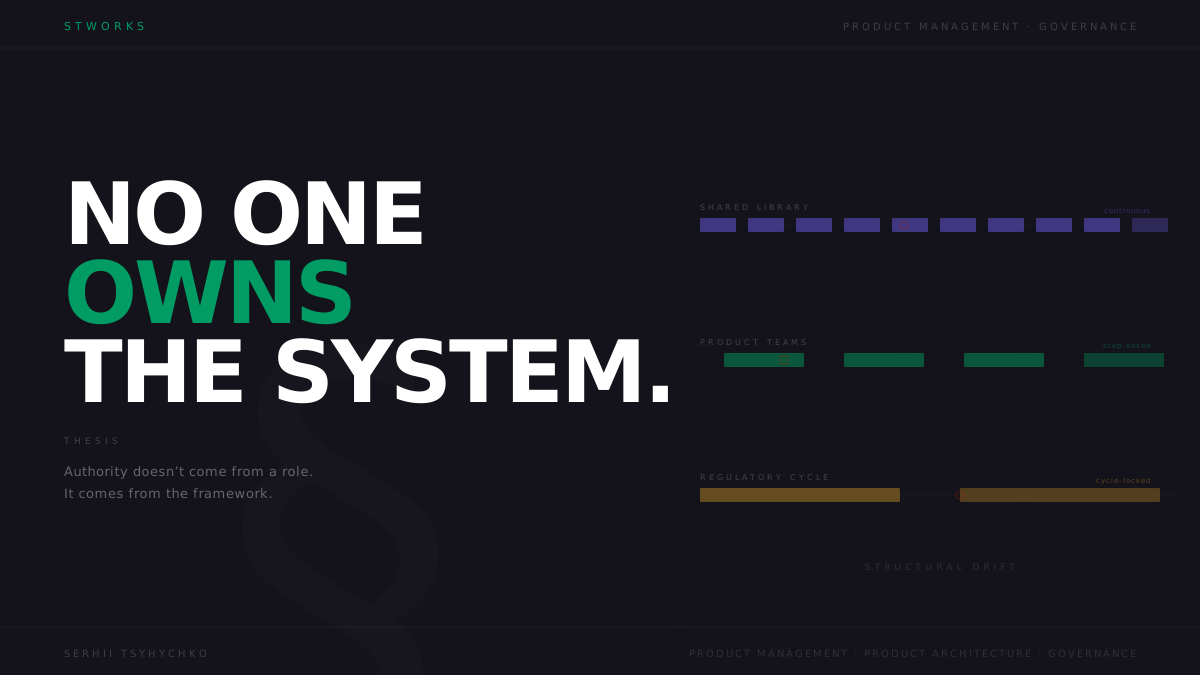
When You Don’t Own the System You Need to Change
When a shared system starts to fail, the issue is often not quality but ownership. In a regulated MedTech environment, multiple independent product teams relied on one common component library while working on frozen validated versions. Continuous library updates and slow product release cycles created structural drift. A component audit…