A system approach to growth under strict capacity constraints
Service Design · Product Strategy · Business Modeling · Operations Design
The practice existed as a set of services without a system behind it. Pricing was intuitive, client intake was uncontrolled, and operations depended entirely on manual decisions.
The business operated under a strict physical constraint of 110 to 120 working hours per month. This made capacity the core limiting resource and exposed the fragility of the model. Any disruption immediately affected income and workload balance.
The product* existed implicitly, but was not defined. There was no structure translating demand into sustainable operations.
* This case applies product architecture principles outside a software context. The domain is a capacity-constrained service business. The approach is the same: define the system before defining the output, model constraints before designing solutions, and replace ad hoc decisions with explicit rules. Domain is secondary. The method is not.
My role
I was engaged as a consulting partner to design a complete business system for a private restorative massage practice operating across two locations.
I owned the full product definition of the practice as a system. This included competitive analysis, client architecture, pricing logic, operational rules, financial modeling, and go-to-market strategy. I worked directly with the specialist and aligned all key decisions at the level of business logic, not execution details.
The outcome was not a set of recommendations, but a fully structured system with defined rules, constraints, and decision frameworks that could operate independently.
Problem
The visible issue was pricing misalignment. The practice operated at the level of low-cost generalists while delivering specialist-level work.
The actual problem was structural. The system had no mechanism to control who enters it, how capacity is allocated, and how value is distributed across time.
This resulted in unstable income, high operational noise, and increasing risk of burnout. In a capacity-constrained model, every incorrect booking directly reduces system efficiency.
The business relied on professional skill alone, without a product layer to support it.
Competitive analysis
The analysis was based on direct observation of local market dynamics across multiple channels, including independent practitioners on marketplace platforms, aggregator listings, and structured service providers.
The market consistently split into three segments.
The first segment consists of low-cost generalists operating without specialization or defined positioning. Pricing is driven by accessibility rather than value, and services are largely interchangeable. Client relationships are transactional, with no retention model or long-term engagement strategy.
The second segment includes mid-tier providers and aggregators offering broader service menus and slightly higher pricing. While these providers appear more structured, they still lack a clear methodology, client selection logic, or systemized approach to service delivery.
The third segment is represented by higher-priced providers, including wellness studios and rehabilitation-oriented specialists. These competitors rely on perceived expertise or environment, but in most cases still operate without explicit client models, capacity constraints, or defined operational logic.
Across all segments, one pattern remained consistent. The service is treated as a unit of execution rather than a system. Pricing is static, client intake is uncontrolled, and relationships are not structured.
This revealed a structural gap. The opportunity was not to compete within existing segments, but to introduce a model where value is defined through controlled client architecture and capacity management.
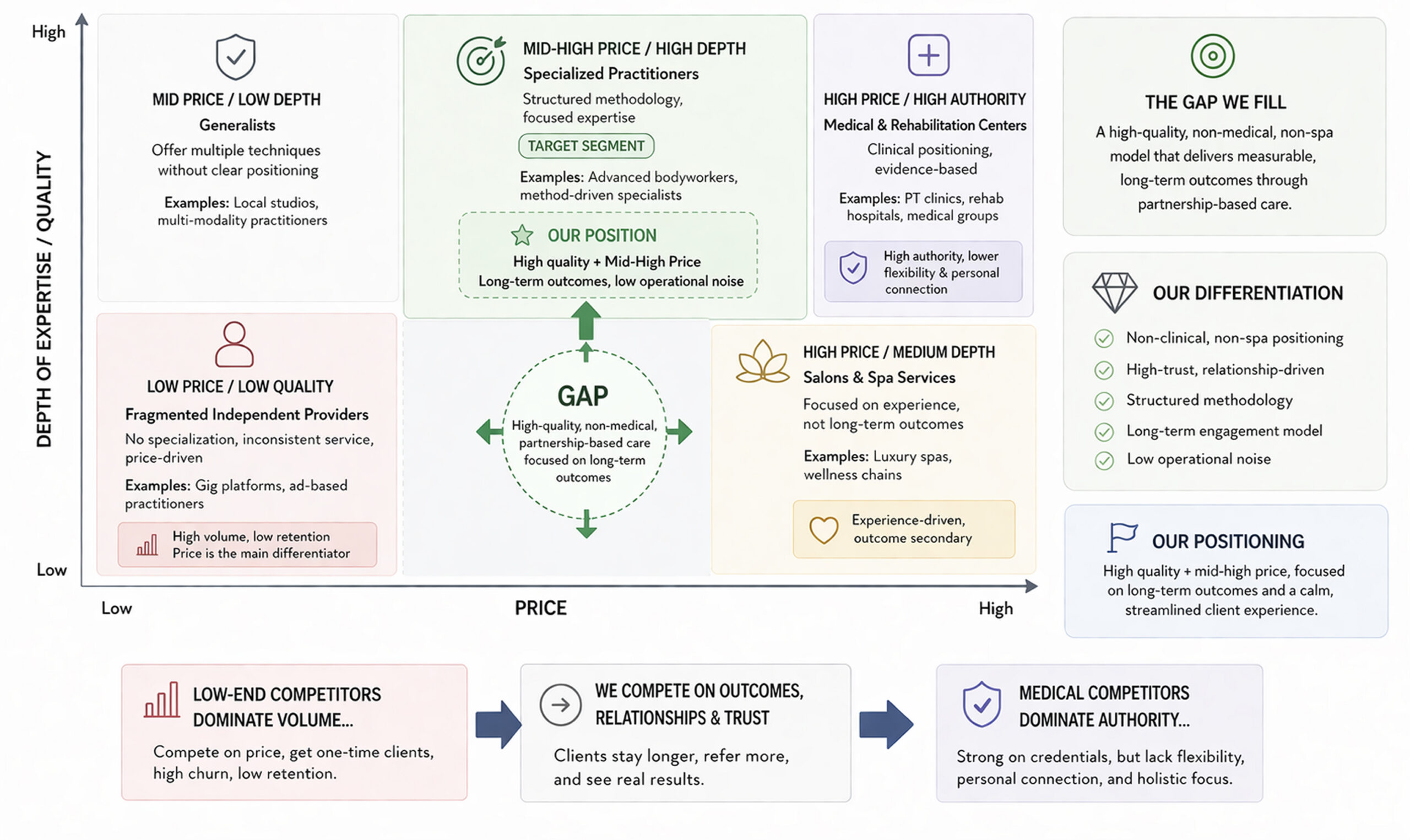
Competitive landscape showing market segmentation and positioning gap
Key insight
A capacity-constrained service cannot scale through volume. It can only scale through the quality of each occupied slot.
This reframes the system. The goal is not acquisition. The goal is controlled allocation of capacity.
Growth becomes a function of selection, not demand.
Solution
I designed the practice as a product system where capacity, client type, and operational rules are explicitly defined and controlled.
At the core of the system is client architecture. Instead of treating all incoming demand equally, the system segments clients based on behavior, values, and relationship model. This allows the practice to prioritize high-value, low-friction clients and deliberately limit segments that create operational instability.
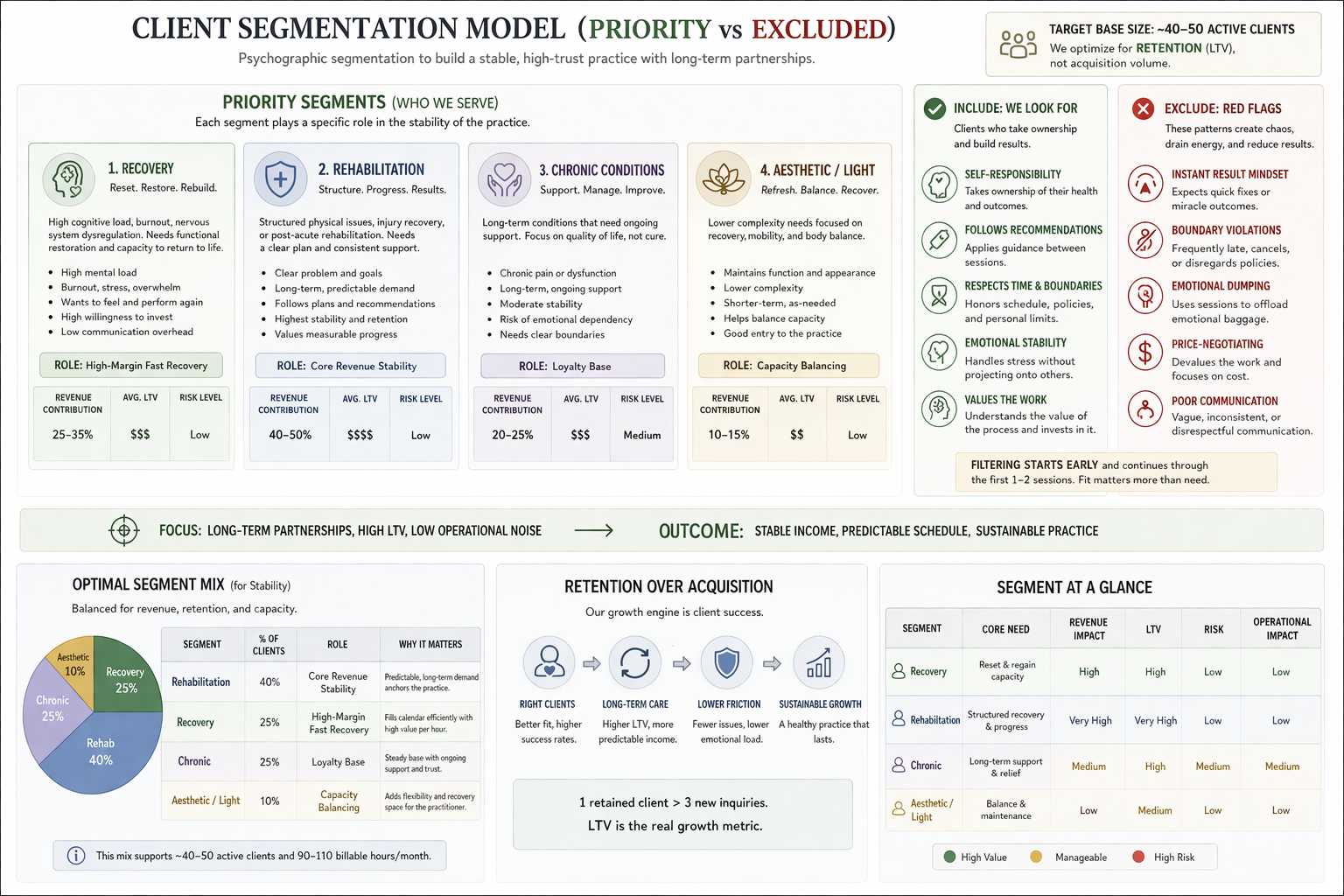
Client segmentation model defining priority and excluded segments
The segmentation model is reinforced by an anti-persona framework that explicitly defines which clients should not enter the system. Entry filtering happens at the first interaction through communication scripts, pricing signals, and booking rules. This shifts control from reactive behavior to system-level governance.
Pricing* was redesigned as an operational mechanism rather than a static value. Instead of a fixed rate, I defined trigger-based pricing rules linked to system state, including utilization levels, waitlist size, and specialist wellbeing. This removed subjective decision-making and aligned pricing with real capacity dynamics.
*Detailed pricing values and escalation thresholds are omitted due to NDA
The financial model* translated these rules into measurable outcomes. It demonstrated that sustainability depends not on maximum output, but on protecting the minimum viable scenario. The system ensures that even under reduced load, income remains above the survival threshold.
*Full financial calculations and exact revenue figures are not disclosed due to NDA
Operations were formalized as a set of explicit constraints. Capacity limits, intake rules, prepayment policy, and location scheduling were defined as system rules rather than flexible decisions. Crisis scenarios were documented with predefined responses, allowing the system to remain stable under disruption.
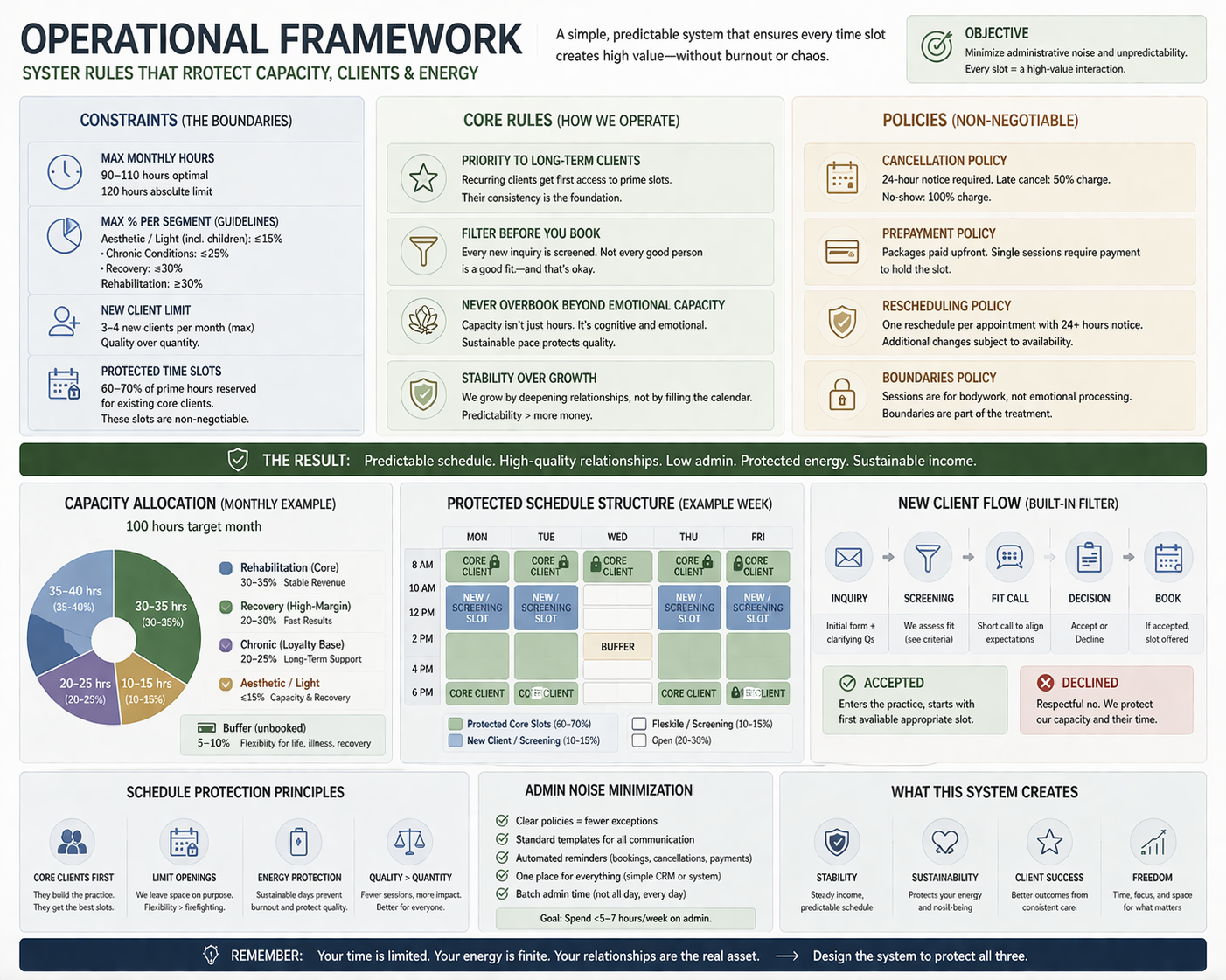
Operational framework governing capacity and scheduling
The customer journey was structured to support filtering, trust-building, and retention. Each stage from awareness to repeat visits was designed to reinforce the positioning and remove incompatible clients early.
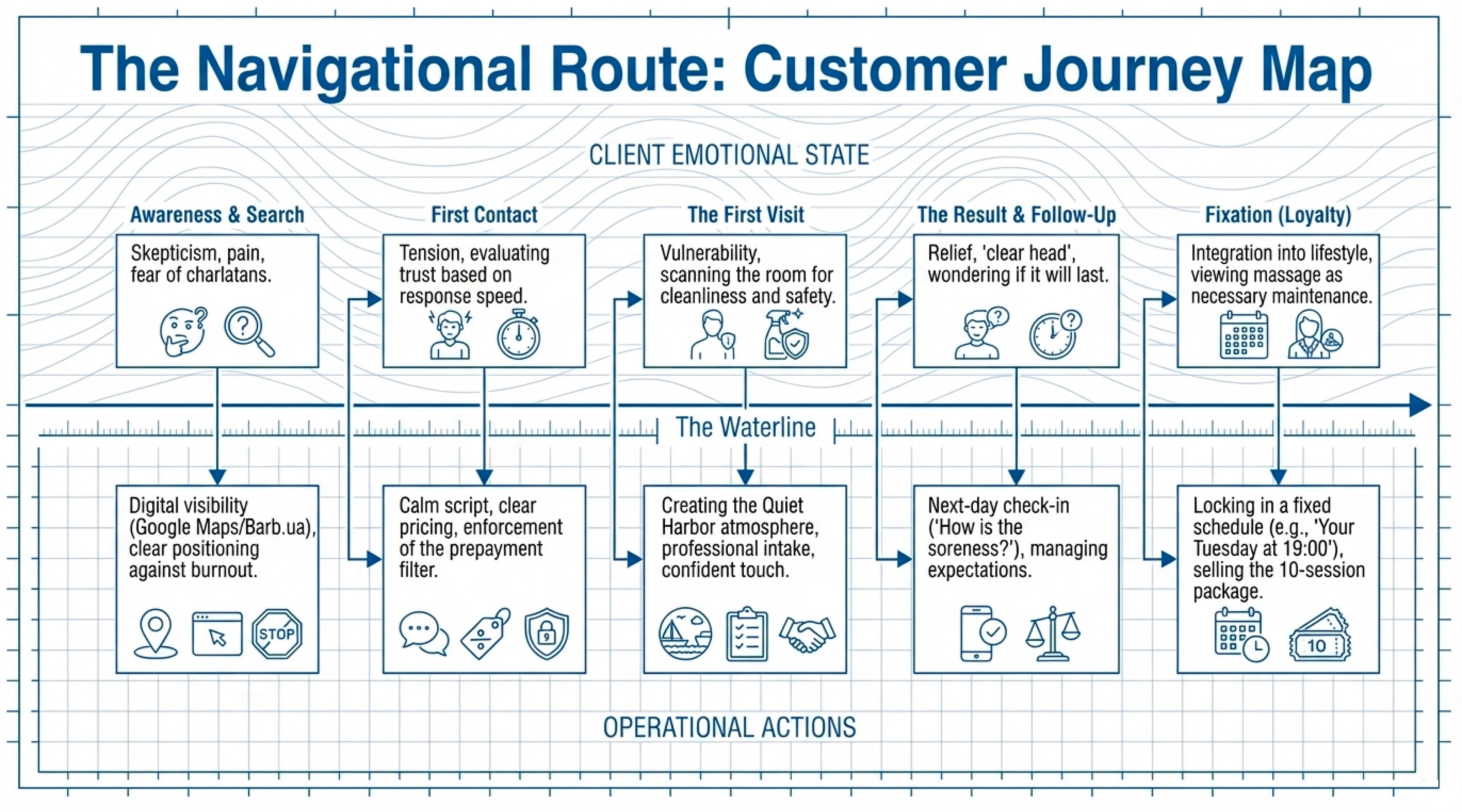
Customer journey map defining decision points
Finally, go-to-market strategy was aligned with the system. Acquisition relies primarily on referrals and partnerships, while digital presence functions as validation. Content strategy was segmented by client type and designed to both attract the right audience and repel incompatible segments.
Key decisions
The core trade-off was between open accessibility and controlled entry. An alternative approach would allow all clients into the system and rely on service quality to manage outcomes. This would maximize short-term demand but increase volatility, reduce predictability, and accelerate burnout.
I chose to design the system around selective access. This reduced potential volume but increased stability, predictability, and long-term value of each client relationship.
Another decision concerned pricing flexibility. Manual pricing adjustments would allow short-term adaptation but introduce inconsistency and emotional bias. Instead, I implemented rule-based triggers, trading flexibility for systemic stability and transparency.
The final trade-off was between growth speed and system integrity. Rapid expansion through aggressive acquisition channels was possible, but it would overload the system. The chosen approach prioritizes controlled growth aligned with capacity constraints.
System artifacts
The solution was supported by a full set of structured artifacts that translated strategy into an executable system:
- Customer journey defining stages, touchpoints, and decision logic
- Psychographic segmentation and filtering model
- End-to-end service flow from first contact to retention
- Scenario-based income and capacity model
- Trigger-based pricing logic
Tools
Figma was used to design system visuals, service flows, and presentation artifacts. NotebookLM supported structuring requirements and building a layered system map. FigJam was used to develop workflows and align system logic. Genspark was used for deep research and competitive analysis. ChatGPT supported validation of system logic and documentation clarity. Trello was used for structuring execution tasks and coordination. Google Drive served as a single source of truth for all documentation.
Result
The practice launched with the system fully implemented as defined.
Pricing was increased at launch by approximately 25 percent, repositioning the practice from a low-cost segment to a specialist tier aligned with the value of the service. A further pricing progression was embedded into the system through predefined triggers based on capacity utilization and workload stability.
Operations were established as a controlled model across two locations with a fixed weekly structure. Capacity limits, client intake rules, and prepayment policies were enforced from day one, replacing ad hoc scheduling with a predictable system.
Client acquisition shifted from uncontrolled demand to filtered entry aligned with the segmentation model. Early intake reflected the intended distribution, with priority client segments forming the majority of new bookings.
The financial model transitioned from a fragile structure dependent on maximum workload to a stable system where reduced capacity scenarios remain above the minimum viable threshold.
The result is structural rather than incremental. The practice now operates as a defined product system with controlled entry, predictable load, and pricing aligned with capacity. Growth is no longer dependent on volume, but on maintaining the integrity of the system.