
As research and execution become cheaper, choosing what to investigate next becomes a larger part of the work.
An experiment can produce reliable evidence without resolving the decision that motivated it. The team learns something, but the result depends on a condition nobody examined.
The familiar discovery sequence remains useful: define a problem, formulate a hypothesis, choose an experiment, collect evidence, make a decision. It describes how to investigate a question. It leaves the dependencies between questions largely implicit.
Across different projects, I encountered situations where progress required changing the object, establishing criteria, checking the instrument, or locating decision authority. More research was not always the next useful step.
Before a Hypothesis Becomes Useful
In an early educational product, the starting point was an idea: help people learn English through video. Research had to help construct the product model itself.
Observation shifted attention from access to vocabulary toward retention. That changed what needed investigation: learning states, review intervals, inactivity, and movement between levels of recall. Evidence about finding content could inform content access. It could not settle questions about retaining knowledge.
The model developed through investigation. As it changed, the questions worth asking changed with it.
In a media platform, the request was to add annotations to rotating product images. Examining the surrounding work revealed users moving between tools to create, position, preview, and manage those annotations.
I reframed the object as an integrated authoring workflow. Interaction preferences remained relevant, but they could not establish whether the proposed capability eliminated fragmentation.
In a regulated environment, several input configurations already existed. The unresolved question concerned their validity across different tasks.
I decomposed workflows by data type, required operations, risk, environment, and failure consequences. That produced criteria grounded in operating constraints. Comparing configurations became meaningful once we could explain what each context required.
These situations contained different kinds of uncertainty. The same discovery sequence could be applied to all of them, but it would not reveal which prerequisite had to be resolved first.
When the Test Changes What the Result Means
While building an AI system, we prepared four live integration checks before user testing. The first request succeeded at the HTTP level, but the application adapter rejected its response.
We stopped the sequence and checked whether the testing script reproduced the application’s model selection.
It did not. The script requested a general model alias; the application used a pinned version. The adapter required exact agreement between requested and returned identifiers.
A local reproduction held response content, completion reason, and token data constant. The identifier mismatch triggered rejection. Matching the identifiers allowed acceptance.
That prevented us from treating the original failure as proof of a defect in the application’s normal path. It did not establish the complete historical cause: the original response body had not been preserved.
We corrected and checked the script locally, then repeated the first live check. After it passed, we ran the remaining three.
All four passed. This justified moving to user testing. It established no product value or release readiness.
Checking one prerequisite changed both the interpretation of existing evidence and the order of further work.
When More Evidence Cannot Unlock Action
I also encountered the reverse situation. In a shared system spanning independent product teams, an audit exposed missing definitions. A structural model anchored to formal specifications was adopted by developers and analysts.
The governance proposal did not follow. Responsibility boundaries and feedback mechanisms received support, but no single role owned the cross-product decision required to formalize them.
The limit was organizational authority. Additional evidence alone could not supply the missing owner.
This case expanded the model for me. Some dependencies determine whether evidence can be interpreted as valid; others determine whether valid evidence can produce action. A decision may be well supported and still remain blocked if the organization lacks the authority or mechanism to put it into effect.
Mapping the Dependencies
These experiences lead me to ask two questions before selecting another discovery activity: what decision is blocked, and what does that decision depend on?
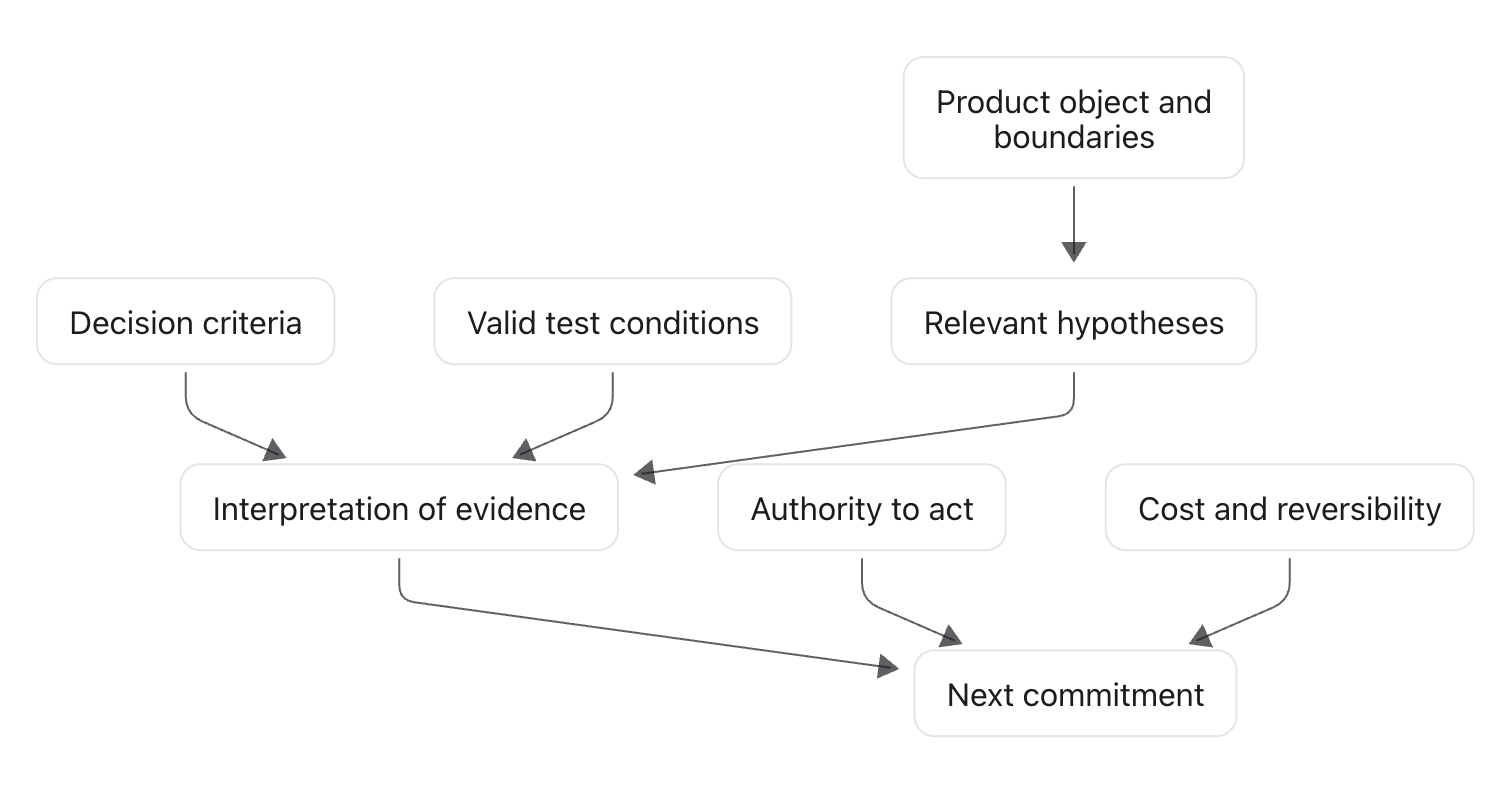
The map does not prescribe a universal order. Customer research can reshape the object. Technical exploration can run alongside demand investigation. Early pricing conversations can be useful before the value model stabilizes.
What remains conditional is interpretation. Stated willingness to pay does not establish delivered value. Technical feasibility does not establish demand. Each result supports a bounded claim.
Choosing the Next Investigation
An assumption deserves early attention not simply because it is uncertain, but because resolving it can change an upcoming decision. I look at the decisions that depend on it, whether available evidence can distinguish the relevant explanations, the cost of obtaining that evidence, and the cost of committing while the assumption remains unresolved.
The widest consequences alone do not determine priority. A broad assumption may be difficult to test, while a narrower question can determine whether a limited pilot is justified.
In the integration episode, the prerequisite was immediately testable and affected every remaining check. That made moving upstream useful.
In the governance episode, further research could improve understanding without changing the ability to act. The next step required ownership.
What Faster Execution Changes
In my AI-assisted work, summaries, comparisons, hypotheses, and prototypes take less time to produce. This makes it easier to accumulate completed activities while a decisive dependency remains unresolved.
The response is to connect each activity to the commitment it can inform. A reversible prototype can proceed with uncertainty that would be unacceptable for a substantial platform investment. An inconclusive result can remain unknown without becoming an artificial rejection.
Evidence also stays attached to its conditions. When the segment, platform, instrument, or product model changes, earlier observations may remain accurate while their relevance changes.
Faster research therefore does not remove the need for structure. It increases it. When producing another analysis, prototype, or experiment becomes cheap, the main constraint shifts toward knowing why that activity should happen now and what its result is allowed to change.
Discovery earns its value when resolving one uncertainty changes what the team is justified in doing next.
Based on product definition and validation work across educational, enterprise, regulated, and AI systems. Confidential details are omitted.